
Cold fingers and uncomfortable feet can take the fun out of skiing. I look at heated accessories through one practical question: do they work with the skier’s equipment?
Heated socks and gloves can provide adjustable warmth during skiing, lift rides, and outdoor breaks. The best choice depends on boot fit, hand movement, heating coverage, battery performance, and moisture protection. For brands and retailers, the opportunity starts with solving these practical needs rather than promising the highest temperature.
Let’s look at real skiing applications, the available market evidence, and what I would check before ordering.
How Do Heated Socks and Gloves Help During Skiing?
A ski day includes fast runs, slow lift rides, and plenty of waiting. I would choose heating products around that changing routine.
Heated ski socks add warmth inside boots, while heated gloves warm the hands without requiring separate handheld warmers. Adjustable heating can help users manage comfort as activity changes. However, suitable insulation, a comfortable fit, and equipment compatibility remain essential; heating cannot compensate for a poorly designed sock or glove.
Think about the whole ski day
Imagine a skier arriving for an early lesson. They walk to the lift, wait in line, sit through the ride, and then start moving down the slope.
The demands on their clothing change throughout that sequence. I would therefore look for heating controls that are easy to understand and practical to adjust when stopped.
This is an established product application. Therm-ic markets heated socks and gloves specifically for skiing, while Lenz offers heated ski socks with a slim-fit design and adjustable heating.
Those examples show that brands already develop products around this use. They do not prove that every heated accessory is suitable for skiing.
Heated socks must work inside the boot
A ski boot has limited space. I would assess the sock and boot together rather than judge softness or thickness on a desk.
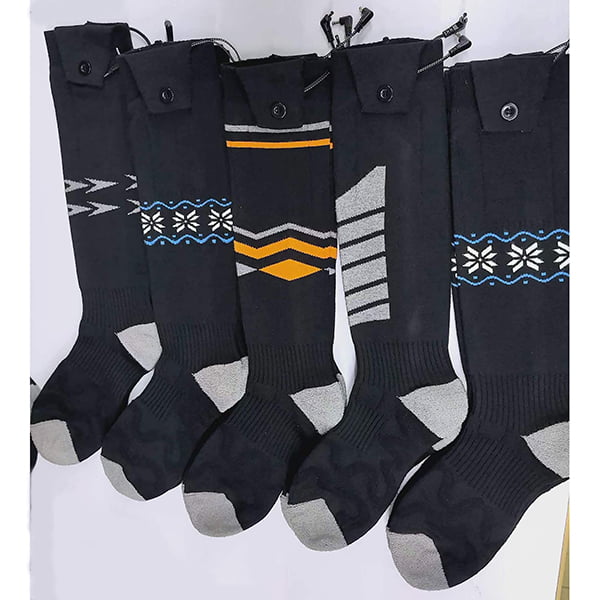
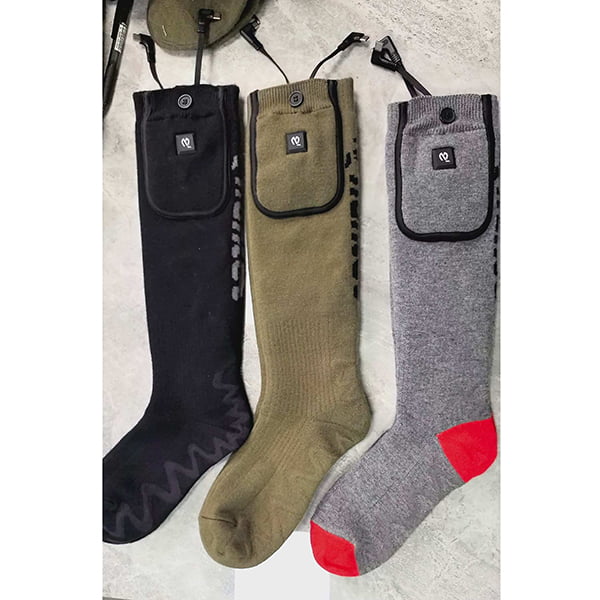
The long socks in our product photographs provide useful starting points for discussing calf coverage, cuff position, and design options. But appearance alone cannot tell me whether a heating element, seam, or cable will feel comfortable inside a particular boot.
During sample evaluation, I would check the fit while standing, bending, and wearing the boots for a realistic period. Battery placement should also be reviewed with the boot fastened and the ski trousers in place.
Heated gloves must allow useful movement
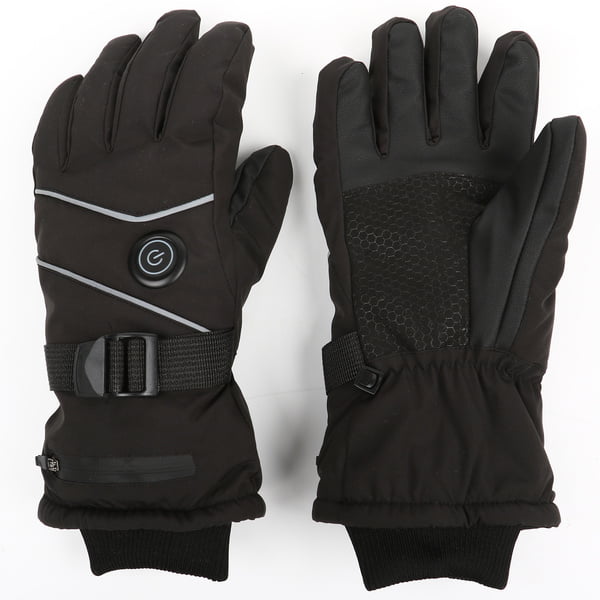
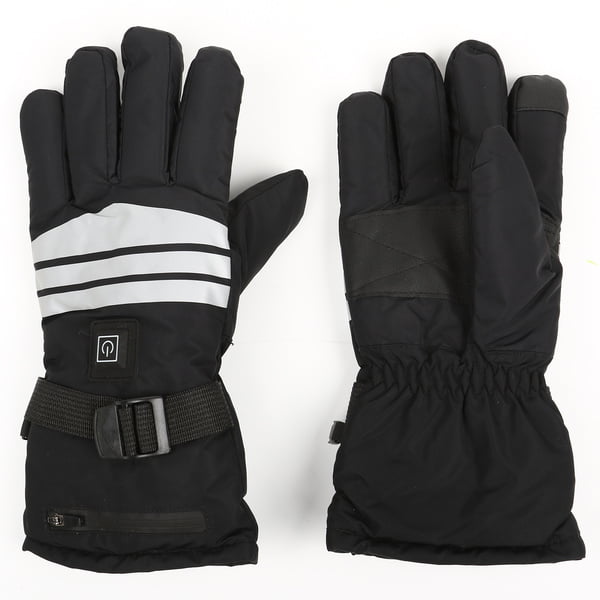
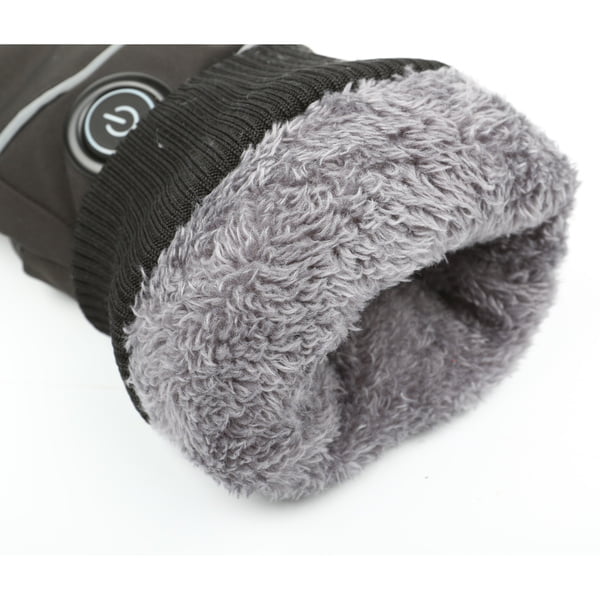
The glove photographs show wrist straps, control buttons, and zipped battery compartments. Some designs also have extended cuffs and visible soft linings.
These details matter because skiers need to hold poles and manage their equipment. I would test grip and button access while wearing the gloves, not simply inspect them flat on a table.
A large battery pocket may look convenient but feel awkward with a jacket sleeve. A secure wrist strap may still be difficult to adjust with the opposite hand covered.
What Do Market Data and Sales Evidence Tell Us About Demand?
A busy ski resort suggests a relevant audience. It does not tell me how many pairs of heated socks a retailer will sell.
Ski participation data show a substantial potential audience for heated accessories, but they do not measure product sales. For winter 2025/26, Domaines Skiables de France reported 56.1 million skier-days in France, 53.7 million in Austria, and 52.6 million in the United States. Category-specific sales still require separate evidence.
Separate market size from purchase demand
The September 2026 season report from Domaines Skiables de France provides useful context. France recorded 56.1 million skier-days, up 2.4% from the previous winter.
The same report gives figures of 53.7 million for Austria and 52.6 million for the United States.
These numbers describe repeated activity. One person skiing for several days contributes several visits. I would never present them as millions of individual buyers waiting to purchase heated gloves.
Still, they help explain why skiing deserves attention when planning a winter accessory range. There is a substantial setting in which warmth, fit, and equipment comfort matter.
| Evidence | What it helps explain | What it does not establish |
|---|---|---|
| Skier-days | The scale of skiing activity | Heated accessory sales |
| Specialist product ranges | Existing commercial applications | Market share or profitability |
| Customer reviews | Questions and reported experiences | Total units sold |
| Retail sell-through records | Purchases within a defined channel | The entire global market |
Be honest about the sales gap
I did not find a publicly verifiable sales total that separates heated socks and heated gloves purchased specifically for skiing.
That distinction matters. Broader heated clothing figures may include workwear, motorcycling, hunting, or everyday winter use. A market forecast is also different from recorded sales.
I would not fill that gap with an impressive number from an unclear source. Buyers need to know what a figure actually measures.
Build an estimate around your own channel
For a retailer, a small test can provide more useful evidence than a broad global forecast.
For example, suppose a shop records 1,000 relevant customer interactions and sells 30 heated accessory sets. That would be a 3% purchase rate for that test, not a market-wide adoption rate.
I would also track selling price, discounts, returns, battery questions, and repeat purchases. Those details help explain whether the product solves a problem customers will pay to address.
What Features Should Buyers Check in Heated Ski Socks and Gloves?
When I review a sample, the power button is only the beginning. Fit, controls, and battery placement deserve equal attention.
For heated ski socks, check boot compatibility, seam comfort, heating coverage, and battery position. For heated ski gloves, assess pole grip, finger movement, cuff fit, and button access. For both products, request documented runtime tests, clear care instructions, and evidence supporting any weather-protection or performance claims.
Evaluate the complete product
The photographs show several glove styles, from a design with raised panels across the knuckles to simpler designs with contrasting stripes. They also show multiple sock colours and patterns.
These are useful choices for a collection, but I would not assume that a sporty appearance proves skiing performance.
For example, raised knuckle panels are visible design features. They do not establish an impact-protection rating. A zipped battery compartment does not, by itself, establish waterproof construction.
I would ask the supplier to connect every important claim to a specification or test result.
Ask better battery questions
“Up to eight hours” means little unless I know the conditions.
Which heat setting was used? What was the surrounding temperature? Which battery was tested? Was the test performed on the finished garment?
I would request results for each advertised setting and ask how the product behaves as battery charge falls. The published claim should match the tested configuration, including the supplied battery.
| Product detail | My sample-review question |
|---|---|
| Sock construction | Can I feel seams or components inside the intended boot? |
| Sock battery position | Does the battery interfere with the boot cuff or trousers? |
| Glove shape | Can I hold a pole comfortably and move each finger? |
| Controls | Can I identify and operate the button while wearing gloves? |
| Heating coverage | Where are the heating elements, and how was performance checked? |
| Care instructions | What must be removed, and which cleaning method is supported? |
Test with the equipment customers actually use
I would review socks with suitable ski boots in more than one size. Gloves should be checked with poles, jacket cuffs, and the supplied batteries installed.
The goal is not simply to produce a warm sample. It is to produce something a skier can wear and operate comfortably.
How Can Brands Develop OEM Heated Socks and Gloves for Skiing?
I would start with the customer’s ski day, then work backward to the product specification, price, and support they need.
An OEM or private-label project should begin with a defined skier profile, target price, and equipment requirements. Agree on materials, fit, heating performance, batteries, packaging, and testing before production. HOWDY welcomes all OEM and ODM orders, with technical details and project feasibility reviewed for the selected product.
Choose a clear customer group
A first-time holiday skier and a frequent mountain visitor may value different things. I would not assume they want the same price, features, or battery package.
For an entry-level collection, clear controls and straightforward instructions may deserve more attention than extra settings. A more specialised range may need closer work on sock thickness, glove movement, and performance under defined conditions.
These are product-development choices, not promises that one version will suit everyone.
Use the photographs to build a focused range
The supplied photographs provide four glove styles and several long-sock designs to discuss. I would use them to narrow the visual direction before investing in extensive custom development.
The glove wrist straps, cuff shapes, button positions, and battery compartments give us concrete details to review. The sock images offer starting points for colour, pattern, and length.
Next, I would confirm the less visible details: materials, heating layout, battery specifications, sizing, and intended use. A photograph is a useful starting point for that conversation, not a finished technical specification.
Compare complete quotations
A lower unit price may exclude batteries, charging accessories, retail packaging, or development work. I would ask suppliers to price the same configuration.
The quotation should also clarify minimum quantities by model, size, and colour. Separate charges for samples, custom components, testing, and packaging make comparisons easier.
For a first order, I would prefer a manageable assortment supported by reliable product information over too many similar versions.
Plan support before launch
Buyers will ask how to charge the product, select a setting, clean it, and obtain compatible replacement parts. Those answers belong in the project plan.
At HOWDY, we work with trading companies, brand owners, and wholesalers through B2B, OEM, and ODM partnerships. Our manufacturing background and in-house controller development provide a basis for discussing custom heating products.
We welcome all OEM and ODM orders. Share your target market, quantity, budget, and intended skiing application so we can review your private-label development requirements.
Conclusion
I would build a ski heating range around proven fit, clear performance, and realistic demand—not appearance or headline numbers.